
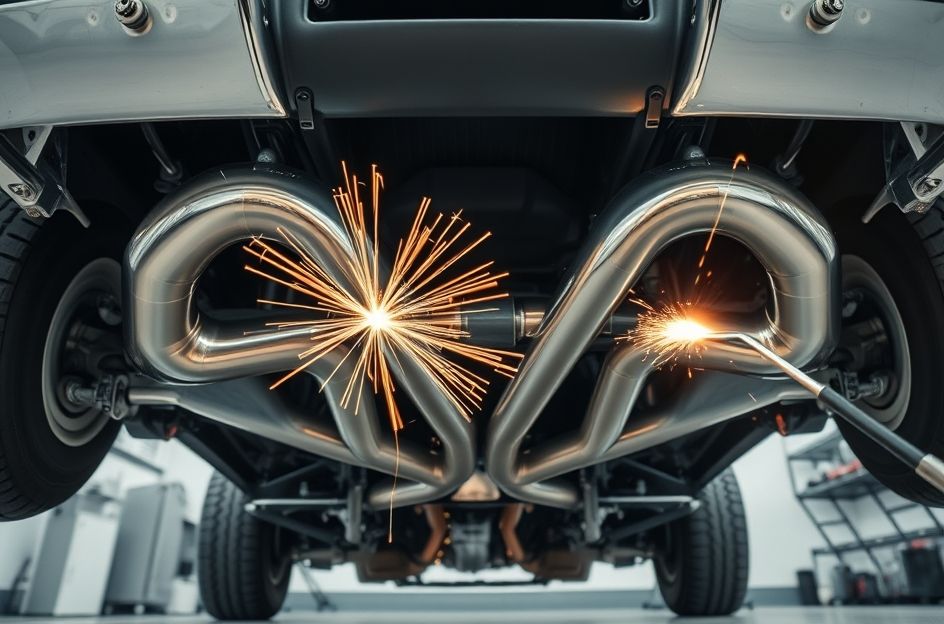
X-pipes are a modification that can significantly improve a car’s performance. While commonly found in race cars, installing an X-pipe on a stock vehicle offers benefits like increased power, improved fuel economy, and reduced interior noise. These aftermarket performance parts can be purchased or custom-made at a muffler shop, with installation simple enough for most DIYers.
The X-pipe’s origins trace back to the H-pipe, developed in the 1960s by American car manufacturers. V-8 engines with dual exhaust systems were notoriously loud due to the lack of sound wave cancellation between the two separate four-cylinder banks. Engineers sought a solution to reduce interior noise and enhance engine power. They discovered that connecting the two exhaust pipes with a balance tube broadened the torque curve, improving engine performance and dampening exhaust resonance.
In the 1990s, advancements in technology led to the development of the X-pipe. Instead of a balance pipe at a 90-degree angle, the X-pipe merges the two exhaust branches, creating a smoother, more direct flow. Today, X-pipes are available for various performance cars, often in off-road configurations without catalytic converters. However, street-legal models equipped with emissions controls are also available.
Why choose an X-pipe over an H-pipe? Extensive testing has demonstrated that the X-pipe design is more efficient, especially at higher RPMs. It enhances both torque and horsepower. The unified exhaust flow in X-pipes leverages the scavenging effect, particularly beneficial for multi-cylinder engines. The seamless connection between the exhaust pipes allows sequentially firing cylinders to more effectively clear spent exhaust gases from the combustion chamber. This makes more room for a fresh intake of air and fuel. As velocity increases in one header tube, it lowers pressure in the adjacent tube, effectively drawing exhaust out of that cylinder. X-pipes excel at this process, especially at high speeds.
Installing an X-pipe is a straightforward modification. Many manufacturers offer bolt-on X-pipes that can be installed in under an hour with basic hand tools. For vehicles without pre-made X-pipe kits, a custom X-pipe can be fabricated at a muffler shop using an X-pipe union and bent exhaust tubing. When creating a custom X-pipe, position the X-pipe union as close to the rear of the vehicle as possible to maximize power gains.
Here’s a basic installation guide: Begin by positioning and securing the passenger-side header pipe. Next, fit the X-pipe along with the driver’s side header pipe, ensuring the longer leg of the X faces the front driver’s side. Loosely attach the pipes to the after-cat system, adjusting the after-cat for proper tailpipe positioning and X-pipe alignment. Secure any exhaust hangars to the pipes, then tighten the bolts and tack-weld the junctions at the X. Double-check everything before removing the X-pipe for full welding of the junctions. Finally, bolt the assembled unit back into position.
In conclusion, installing an X-pipe improves torque and horsepower, leading to faster acceleration, better fuel economy, and a quieter ride. The difference is especially noticeable on V-8 engines. Interior noise is significantly reduced, replacing the distinct pulses of two four-cylinder engines with the smoother sound of all eight cylinders firing.