
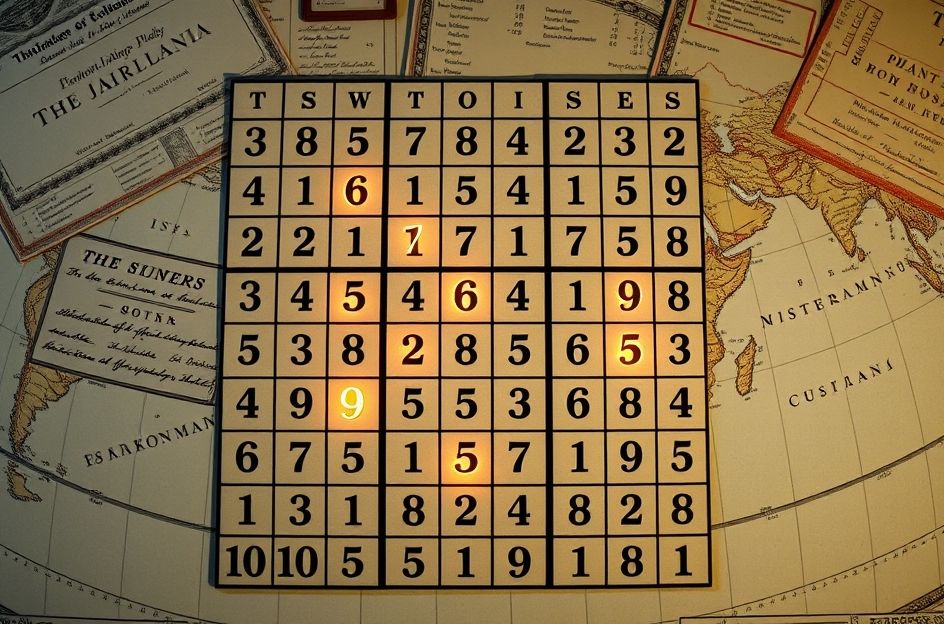
Sudoku, often called the Rubik’s Cube of the 21st century, has become a global phenomenon in the realm of number puzzles. The name ‘Sudoku’ is derived from the Japanese phrase ‘suuji wa dokushin ni kagiru,’ meaning ‘the digits must remain single.’ Contrary to popular belief, Sudoku’s origins aren’t entirely Japanese; only the name is. The puzzle’s story involves contributions from both sides of the Pacific.
The Nikoli Publishing House, renowned for its puzzle publication ‘Monthly Nikolist,’ played a crucial role. They discovered an intriguing number puzzle called ‘The Number Place’ from Dell Puzzle Magazines, an American publisher. In April 1984, Sudoku debuted in ‘Monthly Nikolist’ under the initial name ‘Suuji wa dokushin ni kagiru,’ coined by Nikoli’s president, Kaji Maki. While the first issue saw moderate success, its popularity was partly attributed to the Japanese affinity for puzzles.
Two key developments propelled Sudoku’s rise. First, the name was shortened to ‘Sudoku’ for easier recall and marketing. Second, in 1986, Nikoli introduced two new rules: symmetrical digit arrangement and a limit of 30 given digits. Today, numerous Japanese publishing companies dedicate entire monthly magazines to Sudoku. It’s important to note that ‘Sudoku’ is a registered trademark of the Nikoli Company in Japan, requiring other publishers to create their own brand names for their versions.
Urban legends attribute Sudoku’s creation to puzzle creators in New York, or to Howard Gerns, a retired architect and puzzle enthusiast. These stories agree that Dell Puzzle Magazines first published it in 1979 as ‘The Number Place,’ and that both Gerns and the team drew inspiration from Leonhard Euler’s Latin Square.
In 1776, Swiss mathematician Leonhard Euler presented ‘De Quadratis Magicis,’ demonstrating magic square creation using cells of 9, 16, 25, or 36. He imposed conditions on number variables to form his magic square, which later evolved into the Latin square. Gerns and the team innovated upon Euler’s work by adding a regional restriction and creating a puzzle intentionally.
Wayne Gould, a retired judge, encountered Sudoku in a Tokyo bookstore in 1997. Compelled by the puzzle, he developed a computer program for it between 1997 and 2003. In 2004, he introduced ‘Su Doku’ to The Times of Britain, resulting in immediate success and widespread adoption by other newspapers. Its popularity rapidly spread to Australia and New Zealand, earning it the title of “the fastest growing puzzle in the world” by 2005.
American newspapers, witnessing Sudoku’s global popularity, began publishing their own versions. The New York Post launched its Sudoku version in April 2005, marking the belated recognition of a puzzle that originated in New York over two decades prior. Soon, major dailies like USA Today and The Daily News replaced crosswords with Sudoku.
Sudoku’s appeal transcends language barriers, making it accessible worldwide. The puzzle’s popularity is evidenced by the numerous publications dedicated to it and the many websites and mobile apps offering digital versions. Sudoku continues to evolve, challenging individuals of all ages. Studies suggest that regular Sudoku play offers mental benefits. From a rapidly growing puzzle, Sudoku has transformed into a global phenomenon, inviting everyone to participate.