
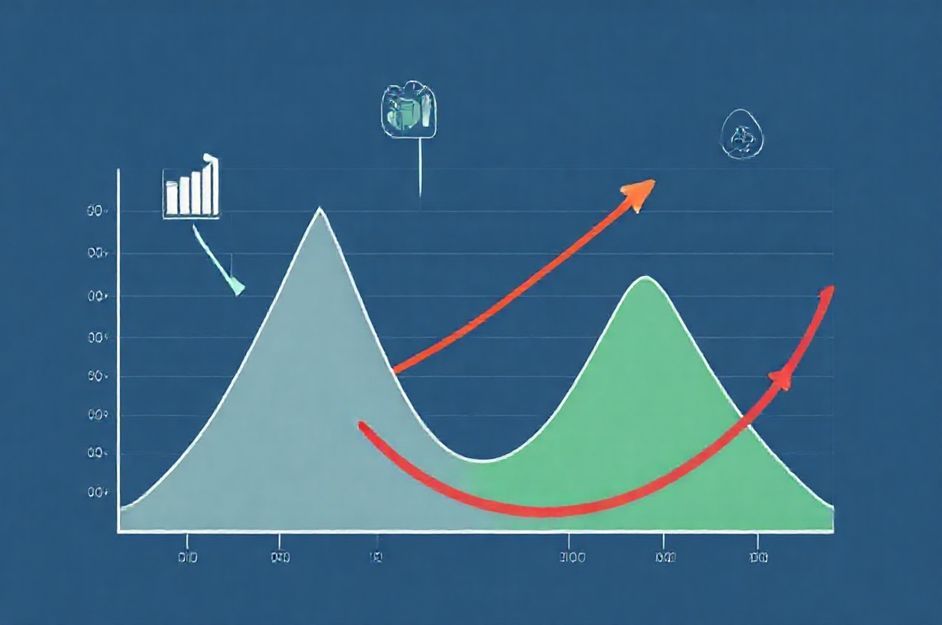
Building upon Part 1, we delve deeper into the intricate relationship between market failures and business cycles. A potentially more damaging scenario arises when savings and investment outpace consumption. Before the Great Depression, the significance of aggregate demand, as highlighted by Keynes, was poorly understood. Government policies often favored substantial investments without adequately addressing aggregate demand.
One key factor contributing to the Great Depression was the US government’s policies, which fostered an uneven distribution of income, heavily favoring the wealthy and diminishing the purchasing power of households. Therefore, the Great Depression could be attributed to investment and savings growing at a disproportionately faster rate than consumption. This imbalance leads to large surpluses for producers in the consumption sector, incentivizing further investment in plant and machinery, perpetuating the cycle for several years. Eventually, the economy faces substantial production capacities with insufficient consumption or buying power.
As production capacities exceed consumer demand, producers become hesitant to invest their surpluses due to already significant unutilized capacities. Consequently, savings are not invested, investment lags behind savings, and money is hoarded, disrupting the circular flow of income. This constriction of demand leads to a corresponding constriction of supply, further exacerbating the situation. The decline in production results in an even greater percentage of unutilized capacities, making new investments less attractive and increasing the amount of hoarded money. The economy enters a vicious downward spiral, causing dramatic income reductions and severe unemployment.
Eventually, a significant investment opportunity encourages entrepreneurs to reinvest the accumulated savings, initiating an expansionary phase. Alternatively, excess capacities may be eliminated due to obsolescence, such as new technologies rendering older plants obsolete. This clears the way for renewed investment and growth. Many business cycles in the US and Europe before the 1930s followed this pattern, driven primarily by investment. These cycles can be termed “Investment-led Business Cycles.”
Stagflation can emerge during consumption-led cycles. After prolonged growth, consumption erodes savings, leading to lower-than-expected surpluses for consumption sector producers. A correction is needed to reduce consumption and increase savings. The magnitude of this correction determines the strength of the subsequent boom. A substantial correction and significant accumulation of savings allow consumption to gradually increase over an extended period, leading to prolonged booms. Conversely, a small correction with insufficient savings limits the duration of the boom, as consumption quickly depletes savings, triggering a recession.
Government intervention aimed at stimulating aggregate demand through expansionary policies, such as interest rate cuts or deficit spending, can inadvertently cause insufficient corrections. While intending to prevent economic decline and reduce unemployment, such interventions may lead to premature expansion before adequate consumption cuts and savings increases occur. As consumption rises, it quickly depletes savings, triggering an immediate recession, leading to further layoffs. Repeated government interventions can exacerbate the problem, leading to continuously rising unemployment. Producers eventually recognize that low surpluses are persistent.
Besides low surpluses, rising interest rates also pose a challenge. Economic expansion leads to increased investment demand. However, with limited savings, the high demand for funds drives interest rates upward. Government borrowing and deficit spending further deplete savings, exacerbating the situation and mimicking boom-time conditions with high interest rates. Abnormally high interest rates contribute to cost-led inflation. High interest rates combined with low surpluses discourage investment and production expansion in the consumption sector. Producers may choose to retain profits without reinvesting or expanding production, resulting in economic stagnation.
Normally, retaining profits would lead to hoarding and paralyze the economy by disrupting the circulation of money. However, government expansionary policies and cost-led inflation discourage capitalists from hoarding, as inflation erodes the value of money. Instead, they spend their retained profits, maintaining the circulation of money.
However, demand does not increase proportionally. Income that would have been distributed among numerous investment workers is now concentrated in the hands of a single capitalist. Consequently, demand for goods suffers despite the money not being hoarded. Capitalists, being high earners, consume a small portion of their income and invest the rest in speculative ventures, such as real estate and shares. This leads to speculative bubbles and soaring inflation. Housing costs rise, reducing workers’ buying power as a significant portion of their income is allocated to housing.
Workers then demand higher wages, leading to periodic wage hike agreements, making inflation a more permanent issue. Unlike some economists’ claims about the unreasonableness of wage demands, wage hikes can provide a small check on capitalists’ speculation, diverting some funds from speculation to wage increases. Overall, stagnation and inflation coexist, leading to stagflation.
The US and other nations experienced a continuous boom during the 1980s and 1990s, primarily driven by substantial investments in IT infrastructure. These IT investments differed significantly from pre-1930s investments, which led to substantial capacity increases and over-investment due to unutilized capacities. IT investments, however, did not significantly increase plant capacities. This eliminated the risk of pre-1930s style depressions, allowing the boom to last as long as IT spending continued. Worker bargaining power was reduced due to fear of computerization, eliminating wage-led and cost-led inflation. Producers could save their surpluses and invest them without increasing costs. Cost cutting ensured that consumption would not erode savings, and savings/investment would not lead to excess capacities. Both types of downturns were avoided, allowing the boom to persist as long as IT spending continued, leading to a virtual absence of business cycles.
In summary, these are the forces that drive business cycles, considering both capitalist savings and household savings, though capitalist savings have a greater effect on margins.