
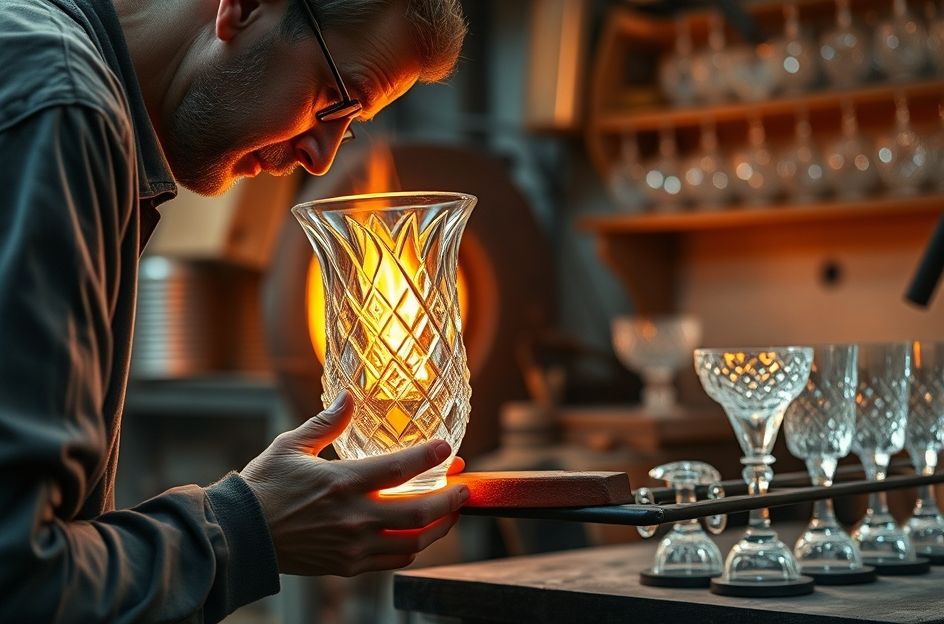
The art of cut glass and glassblowing evolved from ancient practices, gradually refined over centuries. Cut glass objects served as valuable commodities, cherished gifts, and adornments in ancient times. Today, exquisite cut crystal remains highly sought after for its heirloom quality and gifting appeal.
Natural glass, such as obsidian, a dense volcanic glass, has been utilized by humans for millennia. Early humans valued obsidian for its rarity and the sharp edges resulting from its fracturing properties. This inherent sharpness led to its use in spear points and blades.
Early man-made glass consisted of silica sand, plant ash, and lime. Over time, it was discovered that heating glass to a semi-liquid state allowed it to be molded and shaped before cooling into solid forms. In ancient times, glass pieces were prized as substitutes for precious stones, gems, and valuable gifts.
During the first century BC, the technique of melting and blowing glass into usable objects was developed. With the advent of glassblowing, glass items became more commonplace. Vases, bottles, and cruets were mouth-blown and mold-blown during the Roman Empire, typically for everyday purposes.
Common glass often exhibits a greenish tint due to trace amounts of iron impurities in the sand used in its production. Glassmakers learned to create decorative, colored glass by incorporating metallic compounds and mineral oxides like cobalt, resulting in vibrant reds, blues, and greens. The ability to score and cut glass revealed the spectacular refraction of light in clear glass, leading to its popularity and a decline in demand for colored glass.
Around 1000 AD, a significant advancement occurred in glassmaking: soda-lime was replaced by potash derived from wood ashes. This shift distinguished glass from northern Europe from that of the Mediterranean region, where soda-lime remained prevalent. Centuries later, Bohemian glassmakers utilized ashes from beech trees, progressively refining the production of Bohemian “forest glass.”
The 11th century saw the emergence of new techniques for producing sheet glass in Germany. Glassblowers would create spheres and then form them into cylinders, cutting the glass while still hot and flattening it into sheets. Venetian glassmakers improved upon this method in the 13th century. By the late 1300s, Bohemia and Moravia boasted as many as 20 glassworks. The 12th century marked the arrival of stained glass production, another form of colored glass achieved through the addition of metal impurities. Examples of stained glass in churches and monasteries, such as the glass wall mosaic in St. Bartholomew church in Kolin (circa 1380), still exist today.
Venice became the dominant center for glassmaking during the 14th century, pioneering new methods and fostering a flourishing export trade in mirrors, tableware, and decanters. While glassmaking secrets were closely guarded in Venice, glassworkers eventually migrated to other parts of Europe, disseminating their knowledge and skills. As ornate glassworks gained popularity, royalty commissioned decorative glass items as prestigious gifts for special occasions.
Until the mid-1800s, the “Crown glass process” was a primary method for making glass. A glassblower would spin approximately 9 lbs of molten glass at the end of a rod, expanding it into a flat disk nearly 5 feet in diameter, which was then cut into panes. Venetian glass was highly esteemed for over four centuries due to their secrecy in this technique. In 1688, the invention of glass casting made glass and glass panes much more accessible. The glass pressing machine, invented in 1827, enabled mass production of relatively inexpensive glass items. William J. Blenko, an American glass pioneer, is recognized as the first glass producer in America to utilize the cylinder method for creating flat glass by the 1920s.
The Bohemian regions of the Czech Republic and Slovakia remain renowned as two of the world’s finest producers of cut glass and cut crystal. Cut crystal pieces are highly valued as elegant gifts for anniversaries and birthdays.