
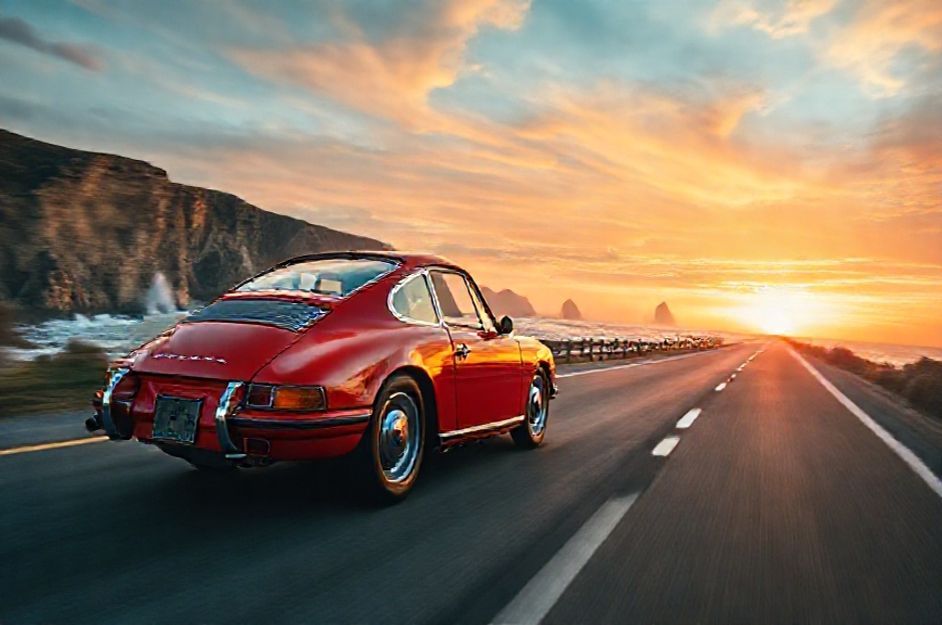
Ferdinand Porsche, a prolific automotive engineer holding over a thousand patents, significantly contributed to aircraft development and tank construction for the Wehrmacht. In the 1920s, he became the chief engineer at Mercedes-Benz in Stuttgart before establishing his independent engineering firm. His designs included the Volkswagen. Post-war, after being interned by the Allies and subsequently released, Porsche collaborated with his son, Ferry Porsche, to create their first automobile.
The Porsche 356, named after Ferry, emerged as a sports car with design cues reminiscent of the Volkswagen. It utilized the same rear-mounted, four-cylinder boxer engine, producing a modest 40 bhp and reaching a top speed of 87 mph (140 km/h). The Porsche 356, available initially as a convertible and later as a hardtop, was celebrated for its elegant and innovative design. Developed in Erwin Komenda’s workshop, a streamlining expert who had overseen sheet metal and design for Ferdinand Porsche since the VW Beetle, the closed coupe style, characterized by its ‘fastback,’ soon became the embodiment of the sports car.
Erwin Komenda and Ferdinand “Butzi” Porsche, the founder’s grandson, perpetuated this design legacy with the iconic 911.
The 911 achieved instant recognition, featuring a sloping hood reminiscent of the 356, distinctive “frog eye” headlights, flowing curves from the windshield to the rear bumper, and a straight waistline. While sharing functional similarities with a BMW 1500, it retained the characteristic stylistic elements of the original Porsche. The 911 became central to Porsche’s identity. During the 1970s and 1980s, attempts to deviate from this design nearly led the company to ruin. Models like the 924, dubbed “a people’s Porsche” and developed with Volkswagen, and the 928 failed to meet expectations and expand the company’s design horizons.
However, in the 1990s, Porsche recognized the market advantage inherent in its classic styling. The company embraced the timeless nature of its designs, leading to increased profitability. A dedicated design department, employing nearly forty people, focused solely on refining the 911. Innovations included the 911 GTI, envisioned by Anthony R. Hatter as a powerful blend of sports and racing capabilities. In 1999, Porsche introduced the Boxster, establishing a second successful model range and solidifying Porsche’s continued design evolution.