
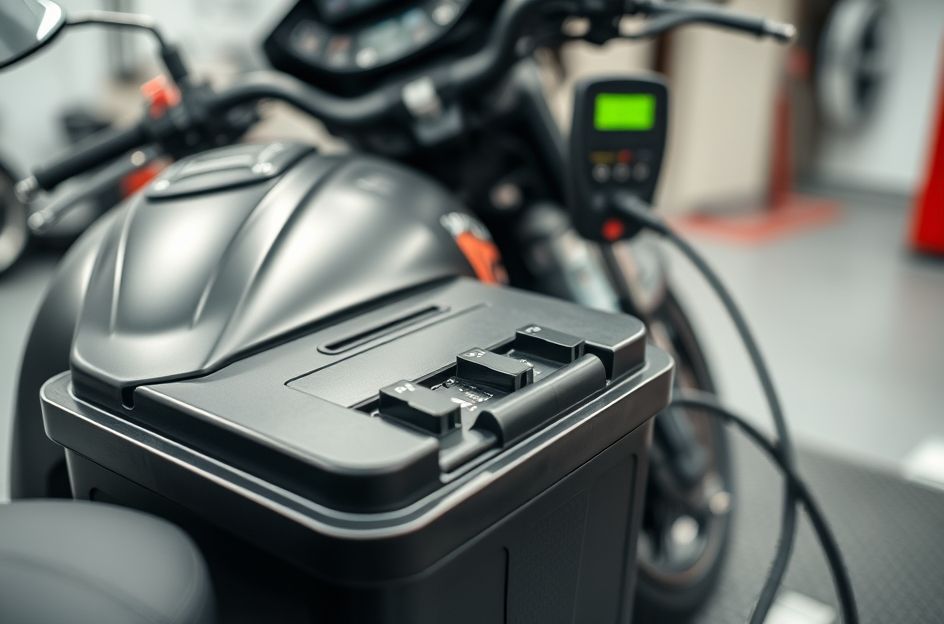
Motorcycle batteries are rated based on their amp/hour (AH) capacity. A 12AH battery, for example, can deliver one amp of current for 12 hours or two amps for six hours. To determine how long a fully charged motorcycle battery will last when powering lights, divide the power in watts by the voltage to find the current draw in amps. For instance, if a headlight and tail light together consume 72 watts on a 12-volt system, the current draw is 6 amps (72 watts / 12 volts = 6 amps). Therefore, a 12AH battery would be depleted in approximately 2 hours.
To properly check a new motorcycle battery, follow these steps:
For batteries that are not maintenance-free and have a vent tube, unwrap the battery, ensure the vent tube is free of kinks, and trim about half an inch from its end. Fill the battery with electrolyte to a level midway between the high and low markings on the case and allow it to sit undisturbed for one to two hours. Note that the battery will only be at about 65% of its full charge at this point. Add electrolyte again if needed.
If your battery is a refillable lead-antimony type, charge it at one-third of its rated capacity in amp/hours for four to five hours to achieve a full charge. Maintenance-free batteries should be charged with a constant-current charger capable of delivering up to 16.9 volts, but this process must be closely monitored to prevent overcharging.
After charging, recheck the electrolyte level and add distilled water if necessary. Allow the battery to cool so that the case contracts sufficiently to fit into its holder. Route the new breather tube, if one is provided, through the original factory routing.
When charging a motorcycle battery, keep these points in mind:
1. Always remember that red indicates positive and black indicates negative to prevent short circuits and electrical shocks.
2. Use a charger that is compatible with the motorcycle battery, with an output voltage slightly higher than the battery voltage.
3. Ensure the connections are clean and the electrolyte level is at the upper level. Do not overfill the cells.
4. Use a battery optimizer, if available, which automatically switches off the charger when the battery is fully charged to prevent overheating, or disconnect the charger manually.
5. It’s advisable to charge your battery every two to three weeks to maintain its health.
6. Batteries with upper and lower level markings should have all cells filled to the upper level, never over or under the lower level.
7. Use only distilled water to top off low cells.
8. New batteries should be charged for at least 8 hours initially.
9. If using a dry battery, fill the cells slowly and let the battery stand for about half an hour before charging.