
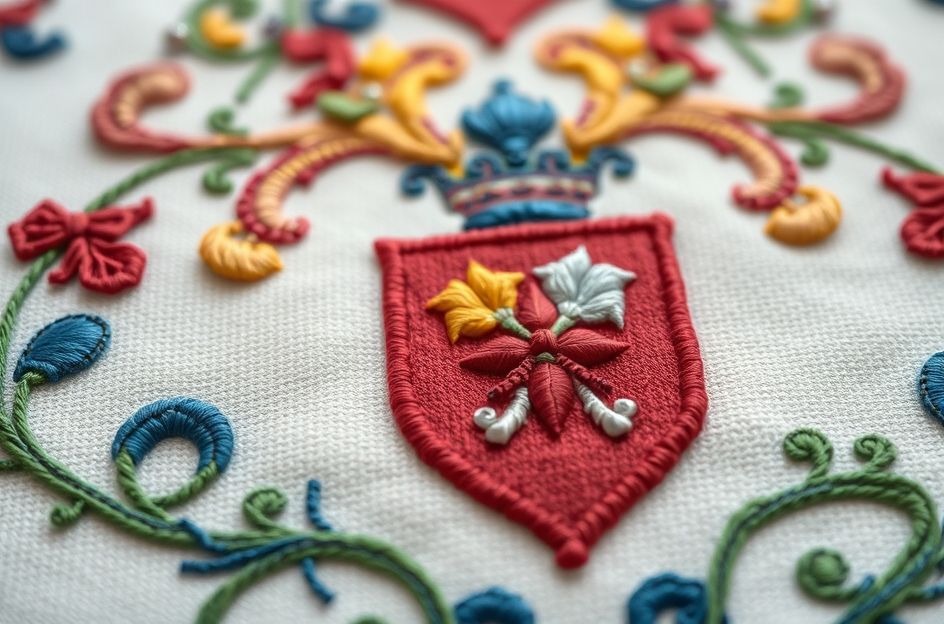
Embroidery involves passing a needle and thread through fabric to create decorative designs. Each pass of the needle, creating a visible mark on the fabric’s surface, is called a stitch. In embroidery, a stitch refers to one or more movements executed in a consistent manner, forming a recognizable pattern or design element. These stitches are the foundational units of embroidery.
Embroidery patterns emerge from the careful arrangement of numerous stitches, whether uniform or diverse. These patterns can be created by following a counted chart, tracing a design directly onto the fabric, or even through freehand techniques. Heraldic hand-stitched embroidery often utilizes specific stitch combinations to create unique and identifiable designs.
Within heraldic hand-stitched embroidery, distinct names identify specific stitches, though these names may vary across different countries and regions. Some embroidery resources include these name variations for reference. While individual stitches are often simple to execute, combining them can yield intricate and complex results.
The process of heraldic hand-stitched embroidery involves using a needle to pass thread through the fabric. The needle is brought to the front of the fabric, inserted back into the material, and then brought back to the surface in a single, fluid motion. The thread is then pulled taut. This technique mirrors the method used in basic hand sewing.
Embroiderers commonly use a thimble on their middle finger to protect against injury. After inserting the needle, the thimble-covered finger helps push it through the fabric. The thumb and index finger then grasp the needle on the opposite side, pulling it through to complete the stitch. Experienced embroiderers can significantly increase their speed using this technique.
Embroidery can be done using an embroidery frame or freehand. Frames, particularly those with adjustable tension, are commonly used to stabilize the fabric and prevent excessive stretching, simplifying the stitching process.