
In lean manufacturing, surplus inventory is recognized as one of the seven key wastes, often referred to as “muda.” Addressing and eliminating these inefficiencies is crucial for enhancing performance across any manufacturing or production environment.
Excessive raw materials, work-in-progress items, and finished goods unnecessarily tie up significant capital within the production cycle. This capital could be reinvested more effectively elsewhere in the business. Furthermore, the handling and storage of surplus inventory consume valuable space, time, and resources, thereby adding to operational costs. By streamlining production lead times and minimizing handling and storage, businesses can free up capital and improve cash flow.
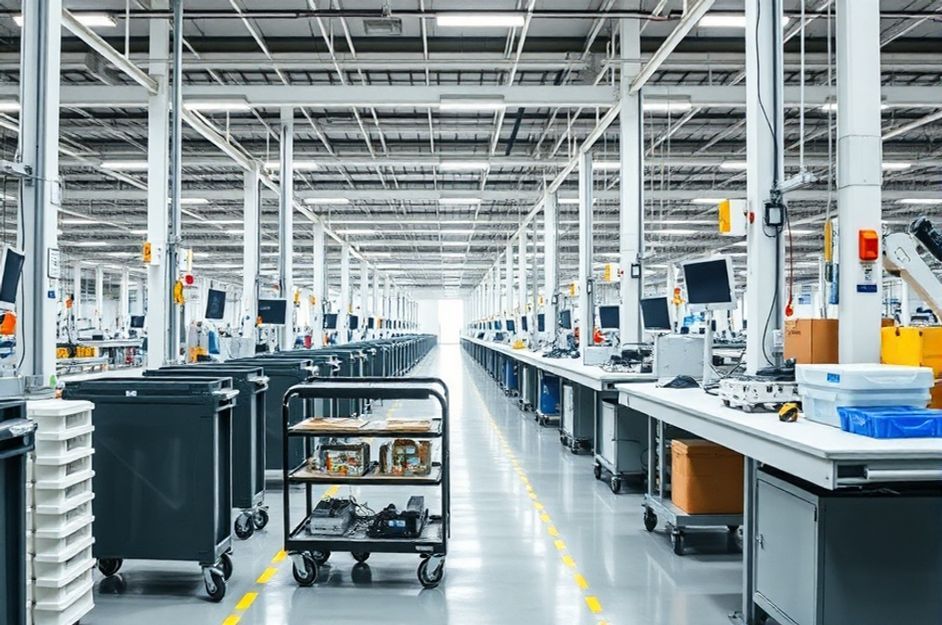
Leading manufacturers have discovered that utilizing modular and adaptable carts, trolleys, and lineside storage solutions facilitates flexible processes. These solutions allow for the efficient delivery of materials and components precisely when and where they are needed, aligning production closely with actual demand.
Modular systems offer the advantage of rapid deployment and easy reconfiguration. New or temporary applications can be quickly established and readily modified to accommodate evolving process requirements. This adaptability lowers the overall cost of implementation and ownership, as components can be reused across various applications.
Specifically designed carts and trolleys can transport precise quantities of specific items directly to the production line. Parts supermarkets, located conveniently at the lineside, can be promptly replenished when stock levels fall below established thresholds. The net effect is a substantial reduction in overall inventory within the supply chain. This approach also empowers manufacturers to inject greater agility into their operations, enabling faster responses to fluctuating customer demands.
Another significant “muda” is unnecessary movement during handling and storage. Unnecessary motion within the work environment prolongs task completion, diminishes productivity, and increases costs. This often occurs when tools, equipment, or components are located in positions that require staff to walk, reach, or stretch to access them.
To counter these wasteful movements, modular workstations and storage areas can be ergonomically designed to ensure that necessary items are readily accessible and within easy reach. The resulting decrease in unnecessary movements accelerates task or process completion, thus boosting productivity and overall performance.
Ergonomically optimized production and storage zones also minimize distractions for staff, reducing the likelihood of errors and contributing to improved product quality.
Adaptable workstations and parts supermarkets can be tailored to occupy the precise space required for the specific manufacturing process, no more and no less. This not only enhances ergonomics but also increases overall production density by enabling a greater number of workstations or manufacturing cells to be accommodated within the same area, ultimately reducing costs per unit.