
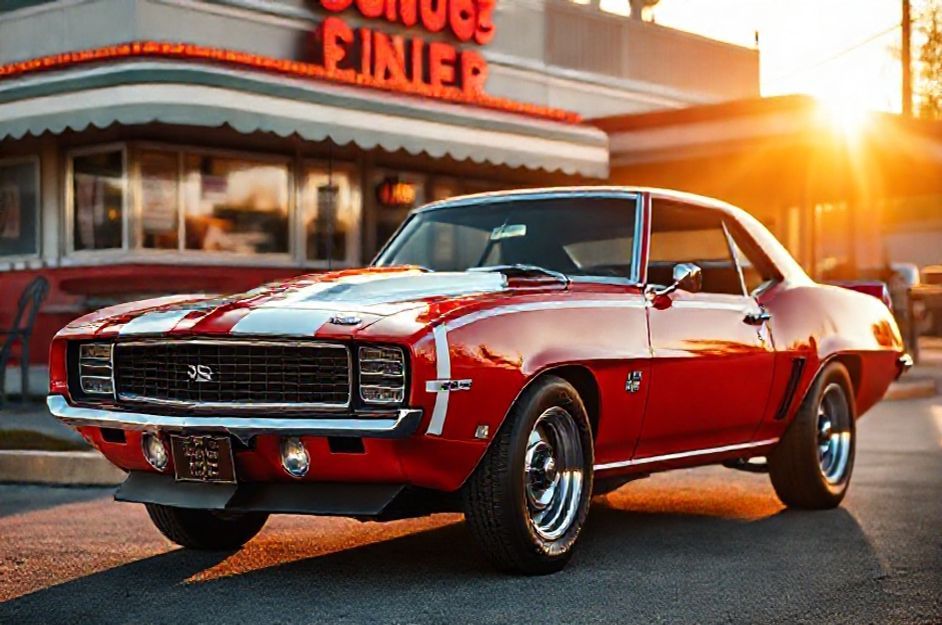
The Chevrolet Camaro, a classic “pony car,” roared onto the scene in 1967 from General Motors, directly challenging the Ford Mustang. Interestingly, the Mustang itself was initially conceived to rival the Chevrolet Corvair Monza. The Camaro’s history is typically divided into four distinct generations: 1967-1970, 1970 1/2 – 1980, 1982-1992, and 1993-2002.
The first generation Camaro employed a unibody structure from the windshield back to the firewall, combined with a separate steel frame for the front. It was offered in both convertible and hardtop versions. Chevrolet provided a wealth of customization options, with eighty factory and forty dealer-installed options available. Engine choices ranged from a 230 cubic inch six-cylinder to a potent 327 V8.
The SS package was immensely popular within the first generation. It featured a modified 350 cubic inch V8, with an optional 396 big block capable of producing 325 horsepower.
December 1966 saw the introduction of the legendary Z-28 option. This package started with a base Camaro and added front disc brakes with power assist and a Muncie 4-speed transmission. Visually, the Z-28 was distinguished by broad racing stripes on the hood and trunk, as well as a competition-tuned suspension.
While the 1968 Camaro saw some minor refinements, such as multi-leaf rear springs, the 1969 model underwent a significant redesign both inside and out. This makeover included changes to the fenders, door skins, grille, and taillights, along with a redesigned dashboard and more comfortable seating. A 427 cubic inch V8 engine also became available.
The second generation Camaro experienced a reduction in power due to increasingly stringent emission regulations and the fuel crisis. The standard engine was a 155 horsepower 250 cubic inch V6. The SS model boasted the largest available engine, a 396 big block V8 producing either 350 or 375 horsepower.
The third generation is notable for the introduction of the IROC-Z, named in honor of the International Race of Champions. Beyond its unique graphics, the IROC-Z featured Tuned Port Injection, boosting power output to 215 horsepower.
The final production year for the Camaro, at that time, was 2002. The Camaro has since been revived and continues to thrill auto enthusiasts.