
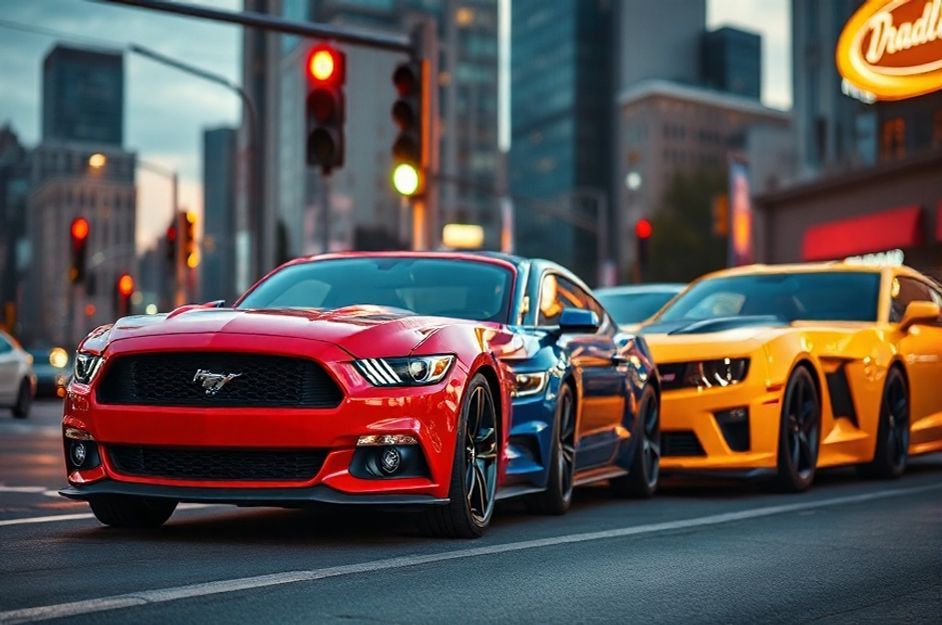
Let’s journey back in time to explore three iconic American performance cars: the Ford Mustang, Dodge Challenger, and Chevrolet Camaro. Currently, only the Mustang is in production, but the Challenger has made a comeback. While GM deliberated, the Camaro, along with its sibling, the Pontiac Firebird, also returned to production. What sets these American performance cars apart? The answer is simple: muscle. This article compares and contrasts these three vehicles, delving into the culture that made them legends.
The Chevy Corvette and Dodge Viper are undeniably performance cars, even race cars. However, the Mustang, Challenger, and Camaro occupy a different space – mass-produced performance cars with raw muscle. There’s a distinct difference in handling, ride, and overall performance between a dedicated race car and a classic muscle car.
Muscle cars were typically coupe versions of larger cars that dominated American roads in the 1960s and 1970s. The Mustang and Camaro, however, were designed as unique “pony” cars, setting them apart. They joined the Dodge Challenger, a performance-oriented version of Mopar cars from that era. Critics consistently compared these three, and with their resurgence, these comparisons continue.
**Ford Mustang:** Picture April 1964, a time of the space race, President Lyndon Johnson, and General Motors’ dominance. Ford, eager to challenge GM, introduced the Mustang at the New York World’s Fair. This 2+2 coupe, borrowing parts from the Fairlane and Falcon, became an instant success, hailed as the best new vehicle introduction ever. With a standard V6 engine and an optional V8, the Mustang shattered sales records. The “retro” Mustang of 2005 reignited interest in the muscle car segment, prompting DaimlerChrysler and General Motors to develop competing models.
**Dodge Challenger:** Following the success of muscle cars like the Dodge Charger and Plymouth ‘Cuda, the Dodge Challenger debuted in 1970. While sharing some components with the ‘Cuda, its sheet metal differed, and the wheelbase was slightly longer. Sadly, the muscle car era was waning, and the Challenger was discontinued after only five years. The concept Challenger, showcased at auto shows, draws heavily from the 1970 design, generating considerable buzz online. Expect Hemi-powered engines and shared technology with the Magnum wagon and Charger sedan.
**Chevrolet Camaro:** GM was slow to react to the Mustang’s arrival. It took nearly three years to launch the Camaro and Pontiac Firebird. While both sold well, they never matched the Mustang’s sales figures. Production dwindled until the Camaro’s end in 2002. However, the retro Mustang’s success has revitalized interest in the Camaro, leading to its return. A new Camaro was introduced, with a convertible version also considered.
Who buys muscle cars today? Primarily, it’s middle-aged men who grew up with the original models. Additionally, a new generation of younger drivers, seeking an alternative to the ubiquitous compact cars, are drawn to the unique style and performance. Modern muscle cars blend the classic aesthetics with contemporary technology, offering improved fuel efficiency without sacrificing power – a true win-win.
The sight of a Mustang, Challenger, and Camaro lined up at a traffic light is an exciting prospect. A new muscle car era is here, and the future looks bright.