
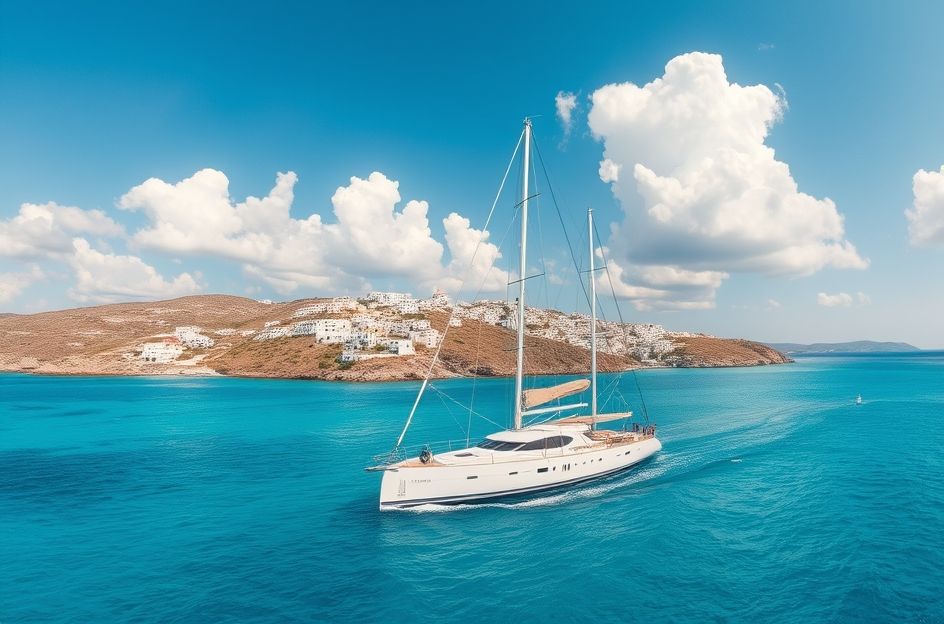
The Northern Cyclades, a captivating island group in the Aegean Sea, offers exceptional yachting experiences. During summer, the Meltemi wind, blowing from the north-northwest, prevails. Starting in June, it intensifies through July, August, and September, potentially reaching force 8 before calming down in October. Spring and autumn often bring gales from the north and southeast. Summer temperatures are hot, averaging 25°C and frequently reaching 35°C.
**Kea (Tzia):** Closest to Athens, Kea blends mountainous terrain with fertile valleys. It’s a tranquil escape offering quiet bays and charming villages. Hora, the capital, houses an archaeological museum showcasing Cycladic artifacts.
According to Greek myth, Kea was home to nymphs of forest springs. When the gods, envious of Kea’s beauty, sent a lion to terrorize them, the nymphs fled. A long drought ensued. Islanders sought help from Aristaios, Apollo’s son, who built a sanctuary to Zeus, the god of rain, appeasing the gods and restoring agriculture.
Korissia, Kea’s port, is located on Limin Ay Nikolaou. Moor stern-to or bows-to, ensuring your anchor is secure against the Meltemi. Vourkari, also in the bay, offers similar mooring. Anchorages are available in calm weather. Fuel, provisions, and tavernas can be found in Korissia and Vourkari. This bay is a popular destination for yachts departing from Athens.
Ioulis, the capital of Kea, is located 5.5 km from Korissia. Many of the old mansions are built next to the ruined castle. The ancient acropolis of Loulis and the impressive sculpture of Kea’s Lion are both worth a visit. As are the churches of Panayia Gamila and Panayia Revmatiani and the ruined monasteries of Agia Anna and Dafni.
South of Korissia are Ormos Pisa and Ormos Kavia, the latter providing shelter from the Meltemi. Manos’ taverna offers provisions, fuel, gas, water, ice, and showers. Ormos Polais, in the southeast, provides some Meltemi shelter, but holding can be unreliable. Khalidhoniki, a small cove in the northeast, offers good Meltemi shelter and a taverna. Orgias, on the north coast, is suitable only in calm conditions.
**Kythnos:** This rocky island lies south of Kea. Settled by the Dryopes in the 11th century BC, Kythnos was praised by Aristotle as a well-organized city-state. Archaeological finds date back to the Neolithic or Mesolithic period. The island is 19 km long and covers an area of about 80 square km. The only green shade in the heat of the summer is provided by many the fig trees. Today the island is popular with Greeks who head for its many Spas that are located in the NE of the island.
Hora, the capital, is a traditional Cycladic village with beautiful churches. Apokriosis and Fikiadha bays on the western coast offer good shelter and sandy beaches. Merika, the island’s port, requires mooring stern-to or bow-to. Fuel is available by taxi, and provisions are readily available. Kanala and Ay Nikolos anchorages, in the southeast, are suitable only in calm weather. Stefanos and Ioannis anchorages, on the east coast, provide Meltemi shelter but have poor holding. Loutra, in the northeast, offers water and provisions at the quay.
**Syros:** Another largely barren island, Syros features a rugged north and cultivated south. Ermoupolis, on the east coast, offers reasonable shelter except during southeast winds. The harbor is known to have sewage issues in summer. Water is available on the quay. Nisos Gaidharos, a small island to the east, offers Meltemi shelter. Varis, in the southeast, provides good Meltemi shelter and tavernas. Finikas, in the southwest, is a sheltered bay with good holding. Galissas and Kini, further north, offer limited facilities.
**Andros:** The northernmost Cycladic island, Andros is mountainous and wooded. Gavrio, on the northwest coast, offers good Meltemi shelter. Batsi, southeast of Gavrio, also provides shelter. Palaioupolis, further south, boasts clear waters. Kastro, on the east side, can be difficult to enter due to the Meltemi. Korthion, to the south of Kastro, offers little protection from the Meltemi.
**Tinos:** South of Andros, Tinos is a rugged, mountainous island with extensive terraced cultivation. Tinos, the capital, offers good shelter except in southerly winds. Panormos, on the northeast coast, is exposed to the Meltemi.