
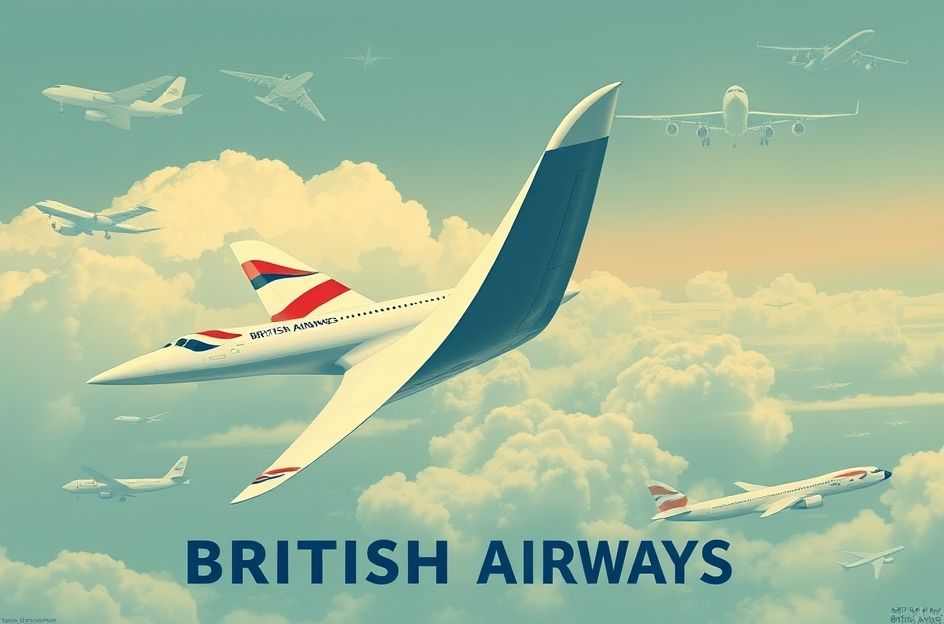
British Airways boasts a rich history spanning over a century. Its origins trace back to 1919, in the aftermath of World War I, when air travel began capturing the public’s imagination. Aircraft Transport and Travel (AT&T), a predecessor to British Airways, launched the world’s first daily international scheduled air service, connecting London and Paris, thereby ushering in the modern era of air travel.
By 1924, several fledgling airlines had emerged in Britain. Recognizing the potential for synergy, Handley Page, Instone, AT&T, and British Air Marine Navigation merged to form Imperial Airways. This larger entity focused on routes throughout the British Empire, establishing itself as a prominent player in international aviation and competing with airships.
In 1935, British Airways Ltd. was established from smaller private companies, rapidly growing to rival Imperial Airways. By 1939, on the eve of World War II, the British government nationalized both airlines, creating the British Overseas Airways Corporation (BOAC).
In 1949, BOAC was divided into two entities: British European Airways (BEA), which operated short-haul flights within Europe, and BOAC, which continued to serve long-haul international routes. These two airlines became symbols of British innovation during the early jet age of the 1950s.
By the 1970s, rising fuel costs and economic concerns prompted the government to consolidate the two entities. In 1974, BEA and BOAC merged to form the modern British Airways, coinciding with the dawn of the supersonic era and the introduction of the Concorde in 1976.