
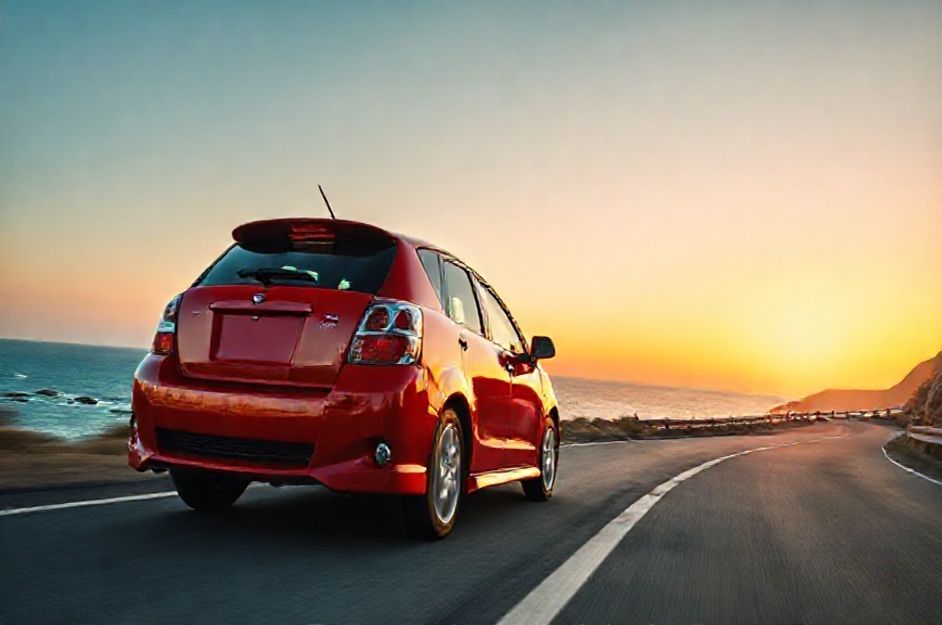
In the early 2000s, Toyota sought to attract younger buyers with a vehicle that offered affordability, fun, and compact dimensions. While the Corolla reliably served this purpose, it lacked the excitement Toyota desired. The solution was the Matrix, built on the Corolla platform, but designed to capture attention with its sporty styling and versatile hatchback design.
Introduced to the North American market in 2003 and manufactured in California as part of a joint venture, the Matrix (along with its twin, the Pontiac Vibe) targeted budget-conscious young drivers seeking a distinctive vehicle. Leveraging the Corolla’s underpinnings, the Matrix distinguishes itself with a taller stance (approximately 3 inches higher) and a shorter overall length (about 8 inches shorter). Its defining feature is the sloping roofline, culminating in a wedge-shaped rear, giving it a wagon-like appearance that enhances both style and cargo space. This design also provides a higher seating position for the driver and front passenger, similar to a small SUV or the Chrysler PT Cruiser.
The Matrix offers both front-wheel drive and, unlike the Corolla, an available all-wheel-drive system. The standard engine is a 1.8-liter DOHC 16-valve VVT-i 4-cylinder, producing 126 horsepower when paired with a five-speed manual transmission. A higher-output version of the same engine delivers 164 horsepower and comes with a six-speed manual gearbox. All-wheel-drive models include a 4-wheel anti-lock brake system (ABS), which is optional on front-wheel-drive variants.
Fuel economy is a major strength of the Matrix. The front-wheel-drive model achieves an EPA-estimated 30 mpg in the city and 36 mpg on the highway, making it one of the most fuel-efficient non-hybrid cars in its class. A 13-gallon fuel tank allows for impressive range, making it ideal for students or anyone with frequent long commutes.
The Matrix enjoys strong aftermarket support, with a wide array of customization options available. These include hood protectors, tail light covers, polymer air dams, fog lights, hood scoops and vents, mud flaps, and paintable window covers, catering to the preferences of its predominantly youthful owners.
With a starting MSRP of around US$15,110 (CDN$17,200) and top-of-the-line models priced just under US$20,000 (CDN$25,000), the Toyota Matrix offers excellent value. Toyota sold nearly 100,000 units annually in North America, demonstrating the appeal of this sporty and youth-oriented vehicle derived from humble origins.